Analyze & review
The Analyzer extracts operations, object bindings, outcomes, and experimental constraints. A human reviews the requirements.
BioAgent matches a biological protocol to its validated skill library, requests targeted human teaching for missing capabilities, and verifies each operation before continuing. Accepted experience supports offline learning and reuse in subsequent experiments.
A robot must identify what it can already do, learn what is missing, and preserve the conditions required by the rest of the experiment.
A protocol-driven loop connects capability-aware planning, targeted skill acquisition, tool orchestration, and verified execution.
The Analyzer extracts operations, object bindings, outcomes, and experimental constraints. A human reviews the requirements.
The Planner reuses compatible validated skills and task packages, then refines only unsupported requirements.
Tools provide policies, aligned replay, perception, and device operations. Missing behaviors request targeted teaching.
The Monitor checks readiness and outcomes, then governs continuation, bounded retry, recovery, or termination.
Accepted demonstrations, execution traces, and corrections support offline policy updates and reusable task packages.
Notebook entries link the requirement, skill version, observations, executed actions, verified result, interventions, and resulting state.
Watch long-horizon biological workflows on the Monte02 dual-arm platform, from protocol analysis and targeted teaching to verified execution and skill reuse.
5:00 · 1080p · English narration · Accelerated real-robot footage; playback speeds are marked in the video.
Download full videoJUMP TO A CHAPTER
Select a chapter to play the corresponding part of the demonstration.
A skill contract specifies what an operation accepts, when it may run, how it executes, and what evidence confirms success. The compact aspiration example below shows the core schema fields.
45+ atomic skill definitions and growing. The registry spans laboratory manipulation, perception, and navigation, including candidate and draft skills. Each capability requires validation within its declared scope before reuse.
skill_id names the behavior; slots declare its objects. Supported parameter values define the scope of reuse.
preconditions define required states; safety lists forbidden conditions and triggers that stop execution.
executor binds the operation to a reviewed policy or tool, its active arm, and the required runtime configuration.
expected_end_state and monitor specify observable success, camera views, and the response to uncertainty.
effects updates the world only after a successful postcheck. failure_handling limits retries and defines the handoff response.
New skills remain needs_validation. training.validation records the evidence required before a reviewed status change enables reuse.
Protocol review, capability matching, targeted teaching, verified execution, and offline consolidation connect one experiment to the next.
A missing aspiration skill triggers a targeted teaching request. Demonstrations and corrections are linked to the requesting operation; accepted data supports an offline policy update, followed by execution validation before reuse.
24-second sequence · Missing skill → human teaching → offline update → independent execution. Footage is accelerated.
Keep supported operations and isolate the missing aspiration behavior.
Collect demonstrations or corrections for the operation, objects, initial conditions, and expected outcome.
Review accepted observation–action data and refine the compatible policy implementation.
Validate the candidate within its declared scope before autonomous execution and subsequent reuse.
Human demonstrations and corrections belong to the learning stage. Formal evaluation begins after learning and permits no human intervention.
Success is measured both at the atomic-skill level and over the full sequence of required experimental outcomes.
Evaluation subset: plate pretreatment and plate washing, with 20 and 31 ordered skill invocations.
50 trials per skill, with recovery disabled.
Separate atomic-skill evaluation on the real robot.
| Protocol | Skill invocations | Without recovery | With recovery |
|---|---|---|---|
| Plate pretreatment & incubator loading | 20 | 27/50 (54%) | 33/50 (66%) |
| Plate washing | 31 | 20/50 (40%) | 29/50 (58%) |
Reported in the BioAgent manuscript, Tables II–III. The evaluated workflows share 19 atomic skills. Atomic skills and complete workflows are evaluated separately. All formal evaluations prohibit human intervention; task-level recovery uses autonomous retries and validated recovery skills.
BioAgent reuses validated skills across different protocols and acquires missing capabilities as new experimental requirements arise. The workflows below illustrate plate pretreatment, incubator loading, and plate washing. Watch the complete recordings on YouTube.
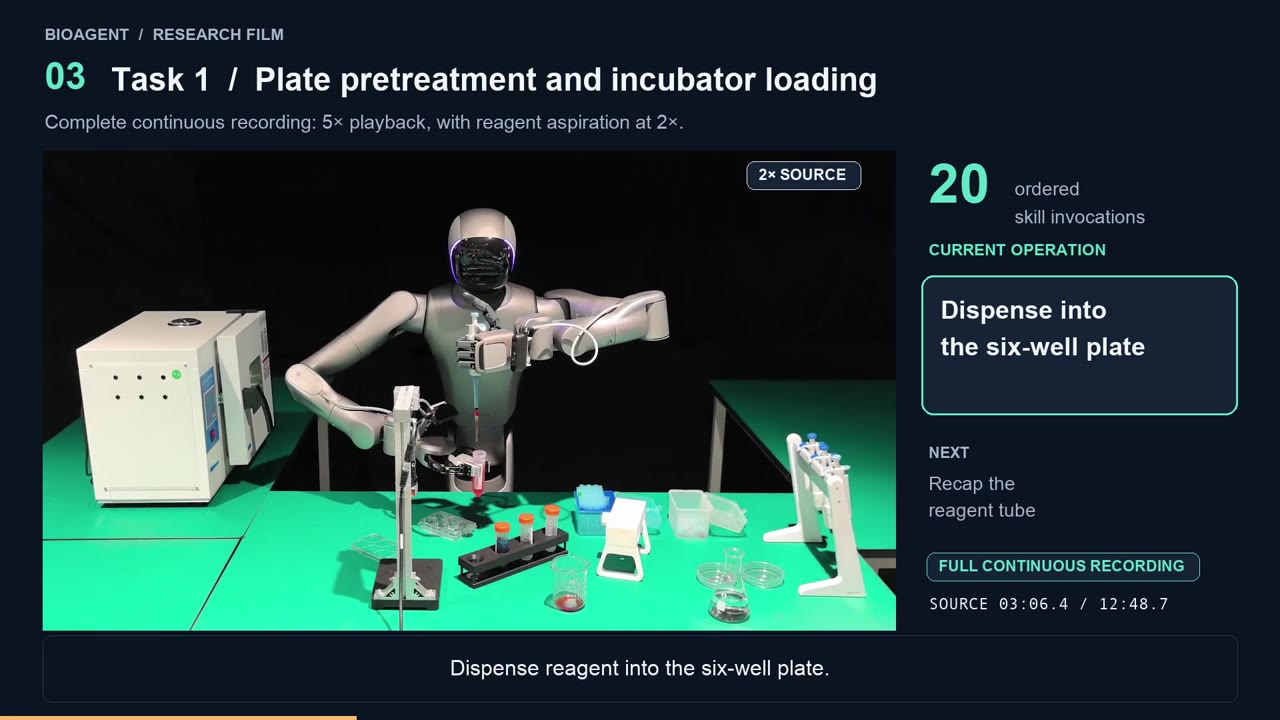 ▶ Watch full Task 1 ↗
Prepare a six-well plate, attach a tip, transfer pretreatment reagent, recap the tube, replace the plate lid, and load the plate into the incubator.
20 invocations · 20 distinct skills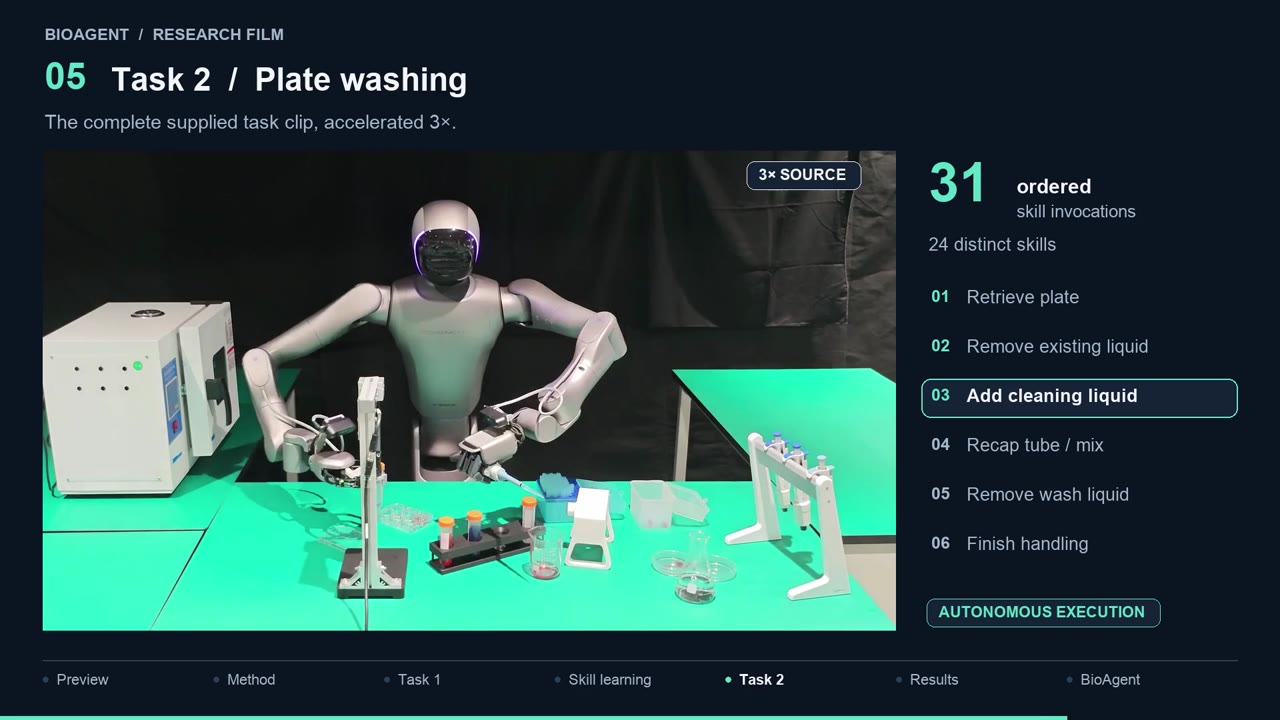 ▶ Watch full Task 2 ↗
Retrieve the plate, remove existing liquid, add cleaning liquid, mix, and remove wash liquid, with pipette-tip changes and tube handling between operations.
31 invocations · 24 distinct skillsA research system for acquiring, verifying, and reusing robot capabilities across long-horizon biological experiments.